
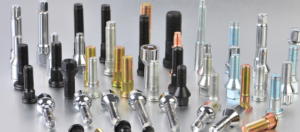
Wheel bolts play a critical role in securing a vehicle’s wheels to the hub, ensuring stability and safety during driving. One important specification of wheel bolts is their strength grade, which indicates the mechanical properties of the bolt, including tensile strength and yield strength.
In this article, we will explain the most common wheel bolt grades – 6.8, 8.8, 10.9, and 12.9, and how to choose the right grade for different applications.
What Are Wheel Bolt Grades?
Wheel bolt grades are classifications defined by the international standard ISO 898-1.
The grade number represents the bolt’s mechanical strength.
For example:
-
The first number indicates tensile strength.
-
The second number represents the yield strength ratio.
Higher grade numbers mean stronger bolts with higher load capacity.
Grade 6.8 Wheel Bolts
Grade 6.8 wheel bolts are considered medium-strength fasteners.
Key characteristics
-
Moderate tensile strength
-
Good toughness
-
Suitable for light-duty applications
Typical applications
-
Light vehicles
-
Small mechanical assemblies
-
Non-heavy load wheel fastening
Although grade 6.8 bolts are reliable, they are generally less common in modern automotive wheel applications compared with higher strength grades.
Grade 8.8 Wheel Bolts
Grade 8.8 wheel bolts are among the most widely used fasteners in the automotive industry.
Key characteristics
-
Higher strength than 6.8
-
Good balance between strength and toughness
-
Reliable under normal driving conditions
Typical applications
-
Passenger vehicles
-
Standard automotive wheel assemblies
-
General mechanical structures
Because of their durability and cost efficiency, grade 8.8 bolts are widely used in many automotive and industrial applications.
Grade 10.9 Wheel Bolts
Grade 10.9 wheel bolts are high-strength fasteners designed for more demanding environments.
Key characteristics
-
High tensile strength
-
Excellent load-bearing capacity
-
Strong resistance to fatigue
Typical applications
-
Performance vehicles
-
Heavy-duty automotive wheels
-
Commercial vehicles
These bolts are commonly used where higher clamping force and reliability are required.
Grade 12.9 Wheel Bolts
Grade 12.9 bolts represent ultra-high strength fasteners.
Key characteristics
-
Very high tensile strength
-
Excellent mechanical performance
-
Suitable for extreme loads
Typical applications
-
High-performance mechanical systems
-
Heavy industrial equipment
-
Specialized automotive components
However, due to their high hardness, grade 12.9 bolts may be more brittle and require proper installation and torque control.
Comparison of Wheel Bolt Grades
| Grade | Tensile Strength (MPa) | Typical Application |
|---|---|---|
| 6.8 | ~600 MPa | Light-duty equipment |
| 8.8 | ~800 MPa | Passenger vehicles |
| 10.9 | ~1000 MPa | Trucks / performance vehicles |
| 12.9 | ~1200 MPa | Heavy-duty machinery |
Higher grades generally provide greater strength and load capacity, but selecting the correct grade also depends on the specific application.
How to Choose the Right Wheel Bolt Grade
When selecting wheel bolts, several factors should be considered:
-
Vehicle type
-
Load conditions
-
Safety requirements
-
Installation torque
-
Environmental conditions
For most passenger vehicles, grade 8.8 or 10.9 wheel bolts provide the best balance of strength and durability.
Conclusion
Understanding wheel bolt grades is essential for ensuring vehicle safety and reliable wheel fastening. Grades 6.8, 8.8, 10.9, and 12.9 represent increasing levels of mechanical strength, each suitable for different applications.
Choosing the appropriate wheel bolt grade helps maintain proper wheel security, improve durability, and ensure safe vehicle operation.